
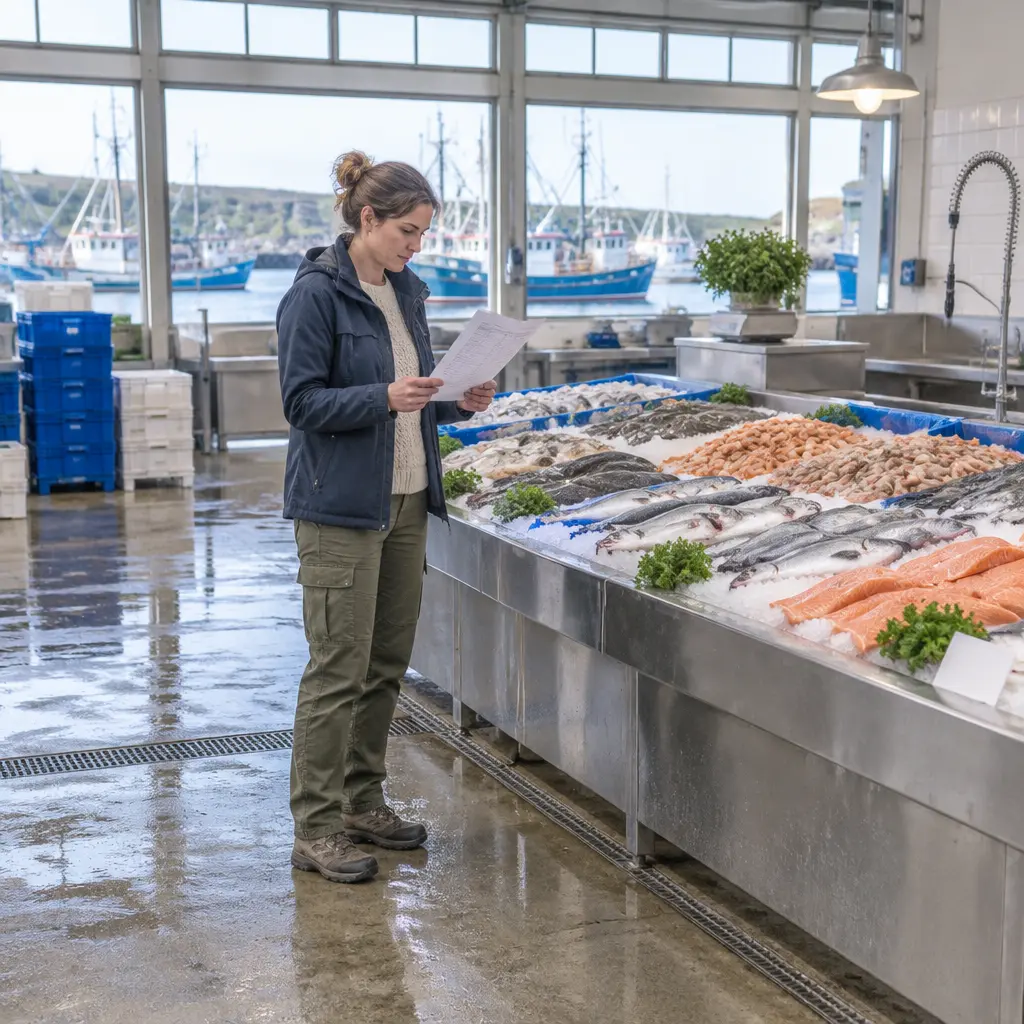
Seafood sourcing transparency is the ability to connect a fish or shellfish product to reliable information about where, when, and how it was caught or farmed. Going beyond a generic menu label such as “wild-caught” means tracing catch method—such as longline, pot, trawl, or handline—and checking that claim against documentation. This matters because the United Nations Food and Agriculture Organization (FAO) estimates that 37.7% of assessed marine fish stocks were being fished at biologically unsustainable levels in 2021. Traceable catch-method information can help buyers assess environmental risks, distinguish products with different impacts, and make claims more verifiable, although it does not by itself prove a fishery is sustainable.
Traceable Seafood Labels Define Sourcing Transparency
Sourcing transparency is the availability of verifiable information about a product’s origin and movement through the supply chain. For seafood, useful traceability can link a menu item or package to species, catch area, harvest date, vessel or farm, and production method. The FAO’s seafood traceability guidance treats traceability as the ability to follow a product through specified stages of production, processing, and distribution. A generic label may identify only a broad category; a robust record can connect that claim to source documents and the lot actually served.
Transparency is not the same as sustainability certification. Traceability answers “Where did this come from, and how was it produced?” Sustainability assessment asks whether the method and fishery meet ecological or social standards. Catch method is therefore a useful attribute, not a stand-alone verdict: the impact of a gear type depends on how it is designed, where and when it is used, and which species and habitats are involved.
Catch-method disclosure
Catch-method disclosure names the gear or harvesting practice used to obtain seafood. Examples include handline, pole-and-line, longline, purse seine, gillnet, pot or trap, and bottom trawl. These are related categories, or hyponyms, of the broader attribute “harvest method.” Naming the method gives buyers more information than “wild-caught,” but the label should be tied to a specific product lot and supported by supplier records rather than inferred from species alone.
Chain-of-custody traceability
Chain-of-custody traceability records a product’s transfers from harvest through landing, processing, distribution, and sale. Each handoff should preserve the identity of the lot or document how lots were combined or transformed. The FAO’s 2022 State of World Fisheries and Aquaculture reported that global fisheries and aquaculture production reached 223.2 million tonnes in 2022, underscoring the scale and complexity of seafood supply chains. At that scale, lot-level records and consistent identifiers are more informative than broad supplier assurances.
The practical bridge between a catch-method claim and a menu is the evidence trail: harvest records support the source claim, and receiving and inventory records connect the purchased lot to the portion served. Without that link, a restaurant may know what a supplier generally sells but not which method produced a particular delivery.
Catch Methods Reveal Different Environmental Risks
Fishing gear interacts with marine life and habitats in different ways. The FAO’s International Guidelines on Bycatch Management and Reduction of Discards identify bycatch—the capture of non-target species—and discarding as important fisheries-management concerns. Method disclosure makes it possible to ask more precise questions about those risks, but context remains essential: gear design, location, season, soak time, and fishery management all affect outcomes.
Trawl and dredge fisheries
Trawls tow nets through the water or along the seabed; dredges are dragged over the bottom to collect shellfish. Bottom-contact gear can disturb seabed habitats, while some trawl fisheries may catch non-target fish, turtles, marine mammals, or other organisms. The degree of risk varies considerably by gear configuration, habitat, and mitigation measures. A label that says “trawl-caught” is therefore a starting point for checking fishery-specific assessments, not enough evidence to characterize every product as harmful or benign.
Longline, gillnet, and purse-seine fisheries
Longlines use a main line with many baited hooks and can incidentally catch seabirds, turtles, or sharks; mitigation may include bird-scaring lines, weighted lines, or hook and bait changes. Gillnets entangle fish and can also capture marine mammals or other species, depending on mesh, placement, and setting. Purse seines encircle schools of fish and draw closed at the bottom; their impacts depend partly on whether fish-aggregating devices are used and how non-target catch is handled. These distinctions show why a broad “wild-caught” claim conceals information relevant to environmental evaluation.
Handline, pole-and-line, and pot fisheries
Handline and pole-and-line fisheries catch fish individually or in small groups using hooks, while pots and traps capture animals in enclosed gear that can often be retrieved. These methods may offer advantages in selectivity or habitat interaction in particular fisheries, but no method is automatically sustainable. Buyers should consider stock status, bycatch, lost or abandoned gear, and compliance alongside the method name. The Monterey Bay Aquarium Seafood Watch program, for example, assesses fisheries and aquaculture operations using species- and production-specific criteria rather than treating a gear label as conclusive proof.
Verification Connects Menu Claims to Evidence
A credible catch-method claim depends on records that survive processing and sale. The U.S. National Oceanic and Atmospheric Administration’s Seafood Import Monitoring Program (SIMP) requires importers of designated at-risk seafood products to report key data from harvest to entry into U.S. commerce. NOAA describes SIMP as covering 13 species groups, representing roughly 1,100 species. The program illustrates how traceability data can support legality and combat illegal, unreported, and unregulated fishing; it is not a universal certification of environmental sustainability, nor does it cover every seafood product.
Documents that support a catch-method claim
Restaurants and retailers can request harvest or landing records, vessel or farm identification, species and catch-area details, gear descriptions, supplier invoices, and lot codes. Where seafood is processed or repacked, records should explain how the original lot maps to the finished product. A supplier’s written specification is useful, but stronger verification includes independent audits, recognized certification where applicable, or reconciliation of source documents with purchasing and inventory records.
- Match the species, harvest area, and method on source records to the supplier invoice and receiving record.
- Retain lot identifiers through preparation, storage, and menu changes.
- Record substitutions and mixed lots rather than carrying a previous claim forward automatically.
- Ask suppliers how they verify method claims and how they correct discrepancies.
Certification and digital traceability
Certification can provide third-party assessment of defined environmental or social criteria, while digital traceability systems can make records easier to share and reconcile. Neither guarantees that every claim is complete: certification applies within its stated scope, and digital records are only as reliable as the data entered and checked. The Global Dialogue on Seafood Traceability (GDST) developed industry standards for interoperable seafood traceability data, helping businesses exchange key information across systems. Buyers should confirm what a certificate covers and whether the digital record reaches the specific product lot.
Restaurants Can Put Catch-Method Transparency into Practice
Restaurants are a critical point of communication because seafood often reaches diners after processing, repacking, and distribution have obscured its origin. A 2021 study published in the journal Science Advances estimated that about 20% of seafood samples tested in its multi-country analysis were mislabeled, with rates varying by place and product. The study is not a universal estimate for every market or restaurant, but it demonstrates why transparent, verifiable sourcing matters.
A practical disclosure workflow
A restaurant can start by identifying priority seafood purchases, asking suppliers for lot-level origin and gear information, and retaining records that connect deliveries to menu items. Staff should be able to explain what a term means and distinguish verified information from details the supplier has not provided. Menus can communicate the method in concise language—such as “pole-and-line caught” or “pot-caught”—while providing additional sourcing details through a QR code, website, or staff explanation. The claim should be updated when the source or method changes.
- Choose a priority species or product and define the information required, including harvest area and catch method.
- Ask suppliers for supporting records and a clear process for lot identification and substitution notices.
- Compare documents across purchasing, receiving, and inventory systems; investigate gaps before making a specific public claim.
- Review sourcing information periodically and remove or qualify claims that cannot be substantiated.
A menu-label example
Consider a menu listing “wild-caught tuna.” That phrase leaves unanswered the catch area, fishing gear, and whether the claim applies to the actual delivery. A more informative statement might identify the species, region, and verified gear method, provided records support each detail. If the supplier confirms only that the tuna is wild-caught, the restaurant should say no more than its evidence allows. This approach protects diners from overconfident claims while giving suppliers an incentive to improve documentation.
A useful chart for staff or diners would compare common gear types across four questions: target selectivity, bycatch concerns, habitat contact, and the documentation available for the purchased lot. Such a chart should explain that risk is fishery-specific and avoid ranking methods as universally sustainable or unsustainable.
Conclusion: Specific Sourcing Claims Need Specific Proof
Traceable seafood labels turn sourcing transparency into practical information: chain-of-custody records connect the product to its source, catch-method disclosure identifies how it was harvested, and verification checks whether those details are supported. Trawl, longline, gillnet, purse-seine, handline, pole-and-line, and pot fisheries present different potential risks, but method alone cannot establish sustainability. For restaurants and seafood buyers, the best next step is to request lot-level records, preserve them through the supply chain, and make only claims the evidence supports. Better disclosure can strengthen accountability and help diners make informed choices; it also gives fisheries and suppliers a clearer reason to improve data quality. Further reading from NOAA, the FAO, Seafood Watch, and the Global Dialogue on Seafood Traceability can help organizations build sourcing policies suited to their products and markets.
Sources: Food and Agriculture Organization of the United Nations, The State of World Fisheries and Aquaculture 2024, https://www.fao.org/publications/home/fao-flagship-publications/the-state-of-world-fisheries-and-aquaculture/2024/en; Food and Agriculture Organization of the United Nations, The State of World Fisheries and Aquaculture 2024: Blue Transformation in Action, https://doi.org/10.4060/cd0683en; Food and Agriculture Organization of the United Nations, International Guidelines on Bycatch Management and Reduction of Discards, https://www.fao.org/3/ba0022t/ba0022t.pdf; National Oceanic and Atmospheric Administration, Seafood Import Monitoring Program, https://www.fisheries.noaa.gov/international/seafood-commerce-certification/seafood-import-monitoring-program; Global Dialogue on Seafood Traceability, GDST Standards, https://thegdst.org/standards/; Monterey Bay Aquarium Seafood Watch, Seafood Recommendations, https://www.seafoodwatch.org/recommendations; Luque and Donlan, “The characterization of seafood mislabeling: A global meta-analysis,” Science Advances, 2020, https://www.science.org/doi/10.1126/sciadv.abc3390.